Medical history
Amniotic membrane has been used in medical care for decades.
Solomon et al., 2001 — read the published research on medical historyFor patients & caregivers
Getting ready for surgery can bring a lot of questions. Understanding the choices in your care plan can help you feel more prepared.
Your surgeon may recommend A-MATRX Micrograft as a donated tissue covering at your surgical site. Here’s what that means, and what you can ask before your procedure.

Donated tissue. A place in your care.
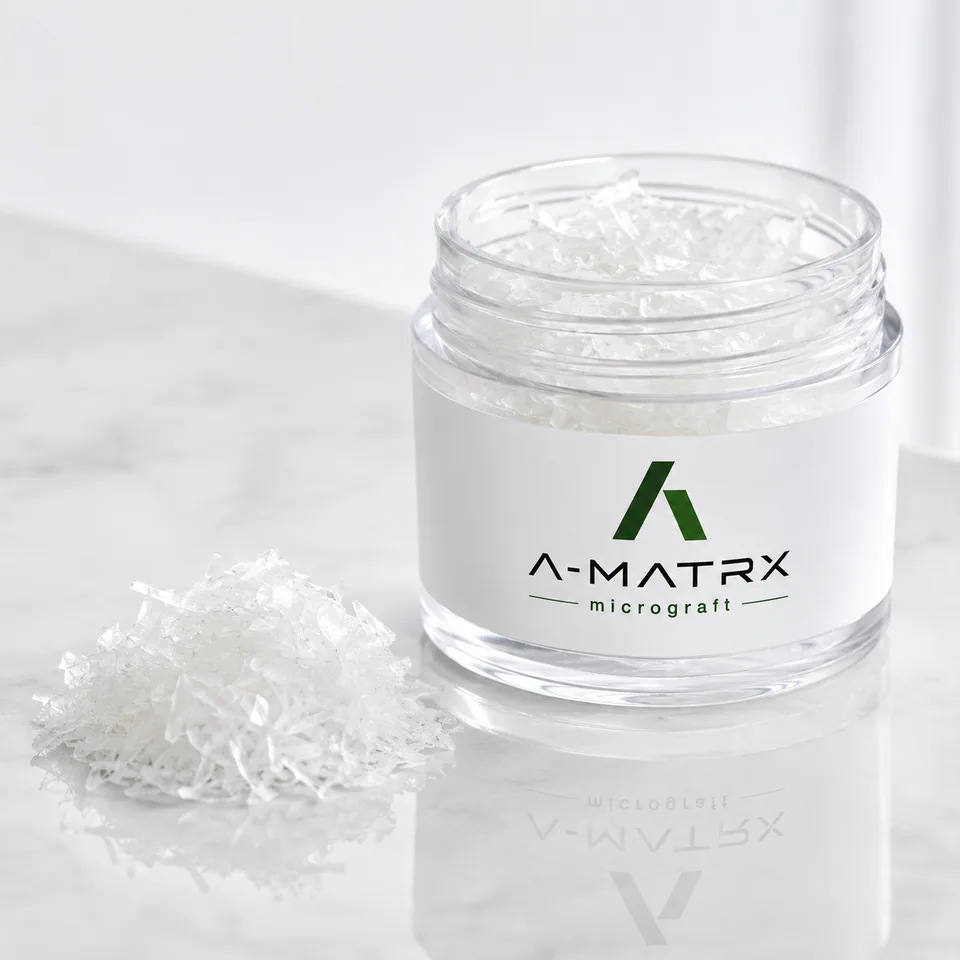
A-MATRX is donated human placental tissue, supplied as small, dry micrografts.
It is made from amniotic membrane. This donated tissue is called an allograft: human tissue used in another person.
Surgical sites can be curved, narrow, or uneven. The micrograft format lets your surgeon distribute tissue according to the shape of the site and focus coverage where it is needed.
Sterile and ready to apply directly, with no mixing or pre-hydration required. Your surgeon determines where and how it is placed.
Placed with your care in mind
Your surgeon may choose A-MATRX as an additional tissue covering at a wound or surgical site.
Ask whether tissue coverage may be appropriate for your procedure. Your clinician determines suitability and placement, consistent with the Instructions for Use.
A history of birth-tissue care
Research on amniotic membrane grafts has reported encouraging findings in specific settings.
These studies evaluated products different from A-MATRX. Ask your surgeon about A-MATRX-specific evidence and possible benefits for your procedure.
Amniotic membrane has been used in medical care for decades.
Solomon et al., 2001 — read the published research on medical historySome wound-care studies have found faster healing with amniotic membrane dressings.
Salehi et al., online 2013; issue 2015 — read the published research on wound healingTendon-repair research has examined reducing adhesions: bands of scar tissue that can limit movement.
Liu et al., 2019 — read the published research on adhesionsSome burn research has reported less raised scarring after skin grafting.
Mohammadi et al., 2017 — read the published research on scarringThoughtful care at every step
Donated tissue undergoes screening, processing, and sterilization before it is available for use.
Donor screening includes health history, a physical assessment, and infectious-disease testing. A medical director confirms that tissue meets release criteria.
A-MATRX is terminally sterilized using gamma or electron-beam (E-beam) radiation.
Human tissue can transmit infection despite screening and sterilization. Tell your surgeon about latex or Triton X-100 allergies or sensitivities; these may be present on the tissue. Contact your care team promptly about any unexpected reaction.
Your surgery. Your questions.
If your surgeon recommends A-MATRX, ask how this tissue covering fits into your procedure and care plan.
Take these questions to your next visit, or share the patient brochure with someone helping you prepare.
Before your procedure, ask your physician or facility whether A-MATRX adds any cost, whether insurance may cover it, and what you may need to pay.
A little more clarity
A-MATRX may be included as a tissue covering within your care plan. Follow your surgeon’s instructions for your procedure, recovery, and follow-up appointments.
Studies of other amniotic products have reported encouraging findings in particular settings. Those results do not establish how A-MATRX will affect your recovery. Ask your surgeon what benefit they expect for your procedure and what evidence supports that expectation.
The care team uses sterile handling techniques. Your surgeon applies the ready-to-use micrografts directly to cover the intended wound or surgical site.
Your surgeon or care team is your first point of contact for questions about your procedure or recovery. Contact them promptly about an unexpected reaction.